Issues /  / Creative Nonfiction

My father’s name was Sebastian or Sammy. Yiano to his sisters who, when he was born in 1931, were so young they could not fully pronounce his name. “Suh-bahs-tee-anno!” said my grandmother. “Yiano!” said they, faithfully reproducing the final sound. It is said that old women can’t hear low-pitched sounds, like the gravelly voices of old men. Old men, on the other hand, can’t hear high pitched tones, like the pursed exclamations of old women. This is how they get along. Children only hear the final syllables. This is why, “No, Tina.” or “Timeout, Tina!” does not work as well as “Tina, for fuck’s sake, NO!”

My father was twenty when he shipped out for the war in Korea, promising my mother, the ballet dancer, that they would marry on his return. So, she gave up her scholarship to college and buckled down, which in immigrant parlance means she took a job, apprenticed to a trade to make money. She became a beautician, not a very good one, who could turn red hair into a green surprise, and waited, which was what all good women of the lower classes did in that day and time.

He never talked about the war. Most fathers don’t. I don’t know why. Men have told me many war stories they would not tell their children or their wives. Over desks. Over beers. Occasionally in my arms. But today my father calls. He has written a memoir about the war. He wants my professional comments. Like him, it will be well-structured and honest to a fault.

My father, like most people, bowed to conformity of his times. “I have one word for you, son,” says Mr. Robinson to Benjamin in the film The Graduate, trying to coerce him into the status quo. “Plastics.” For what it is worth, Mr. Robinson was unaware that he was being cuckolded and that the perpetrator of this cuckolding was young Benjamin. My father, too, was a plastics man, as in Dupont, Interchemical, Olivetti and Dow, but he writes without a trace of plasticity.

“Physicists tell us,” my father writes, “that time is relative. … A moment of intense pain is an eternity in perception. The time I served in Korea was fifteen months, only three months in a combat zone, yet it seems half a lifetime.” He goes on. “At the age of 71,” (Can he be that old?) “I think back in memory to half a lifetime of experiences, which shaped my later life. It seems the greatest part of my past was in combat.” (Not with us? Not with me?) “That was when the experiences were new, intense, and often very frightening.” I had always imagined my birth would be frightening to him, frightening and elating, but after Korea, my mother must have seemed like milk soup. He would have been happy to lay his head in her lap, if she would just sit still. He spent all of his life trying to bring her to stillness–the one thing she could not be.

My father was a Brancato, an honest man who lives in the land of denial. This is not the paradox it seems. To some extent, we all live in denial. No one wants to roam around constantly aware of the reality of his or her own end, for instance, even if death is a certainty. There are levels of honesty from which we need protection, and we have it, not just in the white lies of friends and family but because we cannot attend to all things at once. Where my father registered a blue sky, the warmth of the sun on his face and maybe a splinter in his finger, I would register the shark slipping past the boat, a dark form in the water. If I asked, he would say it was only a shadow. We swam side-by-side at the same moment and in the same sea. Perhaps others would argue otherwise but that is how a child sees it, and I could not grasp how we did not have the same experience–that he could be with my mother, disintegrated as she was, love her, take her to bed. I wanted to believe in my father, not just to believe him. When he told me the little circles I saw when I looked up at the sky were the insides of my own eyes–me seeing the backs of my retinae against a perfect blue sky–then showed me, moving my head side to side, the circles staying still–I believed in him. When he showed me how to gain an extra two whole seconds in the 50-yard dash, by crouching on the starting blocks and leaning ever so slightly on my fingers, he was right. I believed, but what each of us brought to the foreground and what each let slip back was quite different.

What complicated the matter was neither of us could fully control what we saw or did not see, experienced or did not experience. We were different sexes, different ages, the products of different parents in different times. Very young, I could feel my separateness from him and worked against it best I could. Yes father, it is only a shadow. Shadows happen all the time.

My father was born in the depression, about the time Seabiscuit, the improbable horse, stumbled and then rose to fame. In those days, a man would kill for a potato. It does not make for the embracing of a bigger picture. A gang of boys would steal a bag of potatoes to cook them, amidst the refuse of their generation, over an illegal fire. No sharks, my daughter, just shadows that will pass you by.

Perhaps my father was right. I am, after all, still here. Still intact, writing this article, showing pieces of the shadows to my father and anyone who cares to listen.

Nevertheless, most people prefer denying another person’s reality to renouncing their own experience. If I had to come down on one side or the other, I would have to say that it was arguably better for my father to renounce my reality than endorse it. Better that I dealt with two realities, because, in fact, I was the stronger. Recognition of the truth might break him. And then what? It takes a giant to pick, then act, on the reality that is not one’s own–maybe not even anybody else’s–just the one that makes the most positive contribution to the world at large. My father, in his defense of my mother and his attempt to protect us from the truth, tried to be that kind of giant.

My father was so clear about the war in Korea and so obtuse about the war within our family. Or perhaps he saw, and what he saw so frightened him that it was buried with the memories of Christmas Hill, 1953, three years before I was born. “We ran up the hill in one line towards our forward machine gun positions. The night air was filled with incoherent noise. Shouting of orders, machine gun staccato, small arms fire, and loud blasts of exploding mortar shells assaulted my senses. The trajectory of tracer bullets crisscrossed overhead. An occasional flare lit the dark sky as bright flashes of the exploding mortar rounds lit up the trenches ahead of us. Small clouds of smoke and the pungent smell of burning gunpowder filled the air.” Pure poetry. This from a man who, reading Dylan Thomas’s famous poem about raging against the darkness, said: “I don’t understand. What is he talking about … death? Why doesn’t he just say what he means?”

One well-placed bullet and my father would have been gone and I would not be here, then everything that happened maybe would never have happened. It is so, I am told, in some alternative universe somewhere. My father, the scientist, has often speculated upon the fact.

His diary continues. “As I followed my squad leader into this cauldron of hell, I looked down at the peaceful valley to the right. In darkness, with all the confusion, I could easily slip down into the peaceful valley. No one would miss me. The valley beckoned, a safe haven where I was sure to survive the night and return in the morning, unscathed. Up ahead was ‘Hell on Earth’. I might not survive. … I might not. I hesitated. No one would ever know … except me, and I could not live the rest of my life, a coward who deserted his comrades.”

My father was a loyal man. He stayed in his marriage because of us and the church, because of the fear that he couldn’t love his wife and eventually because he loved her. “After a brief hesitation, I ran up the hill following my squad leader to repel the foe.” Here, oddly enough, my father skips the battle entirely, the thing, perhaps, an avid reader like myself might really want to hear and goes straight to: “Suffering an honorable death was preferable to living out one’s life as a coward.” That alone, his omission of the battle, tells me how horrible it was. How fragile my young father. And that such fragility could kill. This is the twisted soul of war. This is its true darkness, like the attraction and repulsion of an ugly lover whose genitals are interesting nonetheless.

My father would have seen his desertion of my mother as a treacherous act, against the family, against the church, against the fabric of a society that, in his own way, he had helped to create. He had withstood the war. He could withstand this marriage. He could straighten the spines of his children so they could withstand it too. He would do so with as much honesty as he could muster, if not with as much truth. There simply was no other alternative.

I want to reach out to my father, boy that he was, man looking back. I want to say, “If only it were all so simple.” I want to cut open the deep hurt inside. I want his rage to be lively, transformative, impactful–like energy through an iron and back. I want to say he couldn’t have been braver, how could he? That he could/did change the world. My father. I am me, after all, and that is no small thing. I want to say he was and is a giant who picked a reality that would make the world a better place, then he made it happen. Is that not what every man wants to achieve? I do not really want him to see the past. Not any of it. Not as it was. In my mind’s eye, I see him as a hero. I imagine him praying. “Father, if it is possible, let this cup pass me by,” but it was not possible, not for him.

The following is what I wrote after I read my father’s memoir.

EXT. CHRISTMAS HILL, 1954 - NIGHT
Shrapnel and mortar fire cut the sky like jewels, plumes of attendant smoke obscuring low stars and a harvest moon.
Under this smoggy blanket, Sergeant BRANCATO (22), Robert Mitchum like, leads a rag-tag team of TWENTY SOLDIERS (17 to 24)–mostly cooks, technicians and medical assistants – up a hill, through successive mortar rounds.
The flack thickens, explosions rocking the countryside.
BRANCATO
Get down! I said, down!
The men drop to their bellies and crawl, with the click clack of their guns in front of them.
TONY BLANDEZ (21), the cook, is hit in the leg, his scream piercing the night. J.J. (18), tech man, scrambles over to help. J.J.’s hit in the neck. He’s gone.
LIEUTENANT BRADY (20), aka Snake, is also hit. Brancato crawls to him, turns him over.
BRANCATO
Brady?
There’s a hole where Brady's stomach was. Brancato reaches up and closes Brady's eyes.
The men keep crawling forward, taking enormous flack. Brancato finally grabs the com.
BRANCATO (ON COM)
We’re getting’ hit bad. We need rein-
forcements.
COMMANDER (V/O)
Roger, Sergeant. Hold your ground.
A vast explosion, a crater: FIVE MEN tossed in the air.
BRANCATO
Hold what ground?
Brancato watches the bodies fly apart. A leg, still in pants, is caught in a tree. Corona, a.k.a. MAILMAN (17), starts to cry
Brancato, deafened by the blast, jumps up, waves his arms and shouts. At least, he thinks he’s shouting.
BRANCATO
Pull back. I said, pull back!
But the men, stunned, cannot hear him. He cannot even hear himself.
BRANCATO
Aw, shit!
Brancato grabs the nearest PRIVATE, drags him to his feet, and pushes him along. The men, understanding now, follow quickly, crouched and low to the ground.
Mailman suddenly screams. The kid’s foot is caught on a land mine. He cannot move forward. He cannot move back.
Brancato pauses. Looks down. There is nothing he can do here. Mailman knows he must not move.
The troops continue on, Brancato following. A moment later, Mailman’s body is rocked by machine gun fire.
Brancato turns back and watches as Mailman, still struggling to stand, drops to the ground and explodes.

What one does not know one imagines. It is the insanity of the writer to go back and try to see what was unseen, to let the action hit the mind’s eye, full-force. That’s life, but ironically, no it is not. It is only a movie.

Most of our foot soldiers in the Korean War were in their late teens or early twenties. Training and fitness cannot completely explain why these men persisted in their duty. Loyalty was one reason. Bravery, another. I think love was the main reason my father stuck it out, rooted in a deep compassion for his fellow foot soldiers, his devotion to his men, his hatred of destruction.

My father and I have a lot in common. It is not that we are not afraid. It is just that we are braver than most people and that we love too much. He is structured, duty bound, while I am his reckless daughter. Stoic on the outside, loyal to the depths, tethered to one another by the slightest sharpest shadow, we have both survived.

Paula C. Brancato

Paula Brancato is a NY-based writer, poet and filmmaker. One of the first women on Wall Street, and a McKinsey consultant and a planner for the World Bank. She is now CEO of her own financial firm—experiences that have added to her unique creative voice. Paula's literary awards include The Booth Poetry Prize, Danahy Fiction Prize and Brushfire Poet Award. Her work has appeared in The Southern Review, Kenyon Review, Mudfish, Bomb Magazine, Virginia Quarterly, Ambit Magazine, Georgetown Review, Litchfield Review and Southern California Anthology, among others. She is currently working on a full-length poetry book, The Bestiary and a first novel called Wild Joy. Paula taught poetry and screenwriting at USC, Stonybrook Southampton and the Harvard Club of New York. She’s a graduate of Harvard Business School, Hunter College and LA Film School and lives in New Jersey with her partner Jason and their 60-pound furbaby, Myrtle the Dog

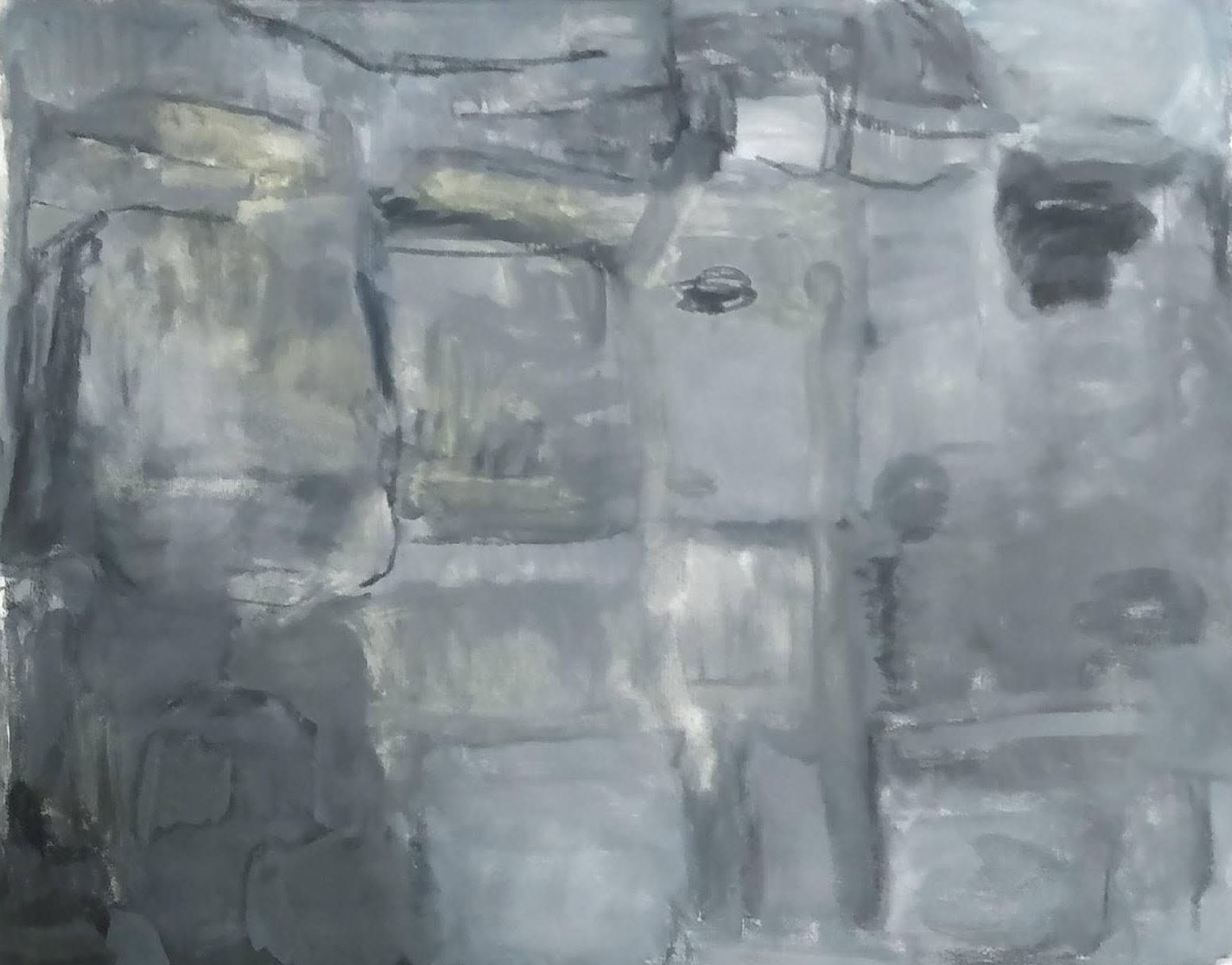
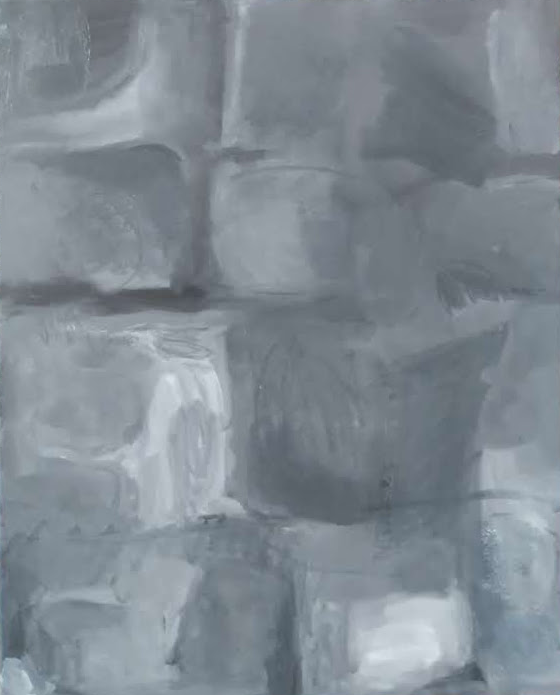
paper texture

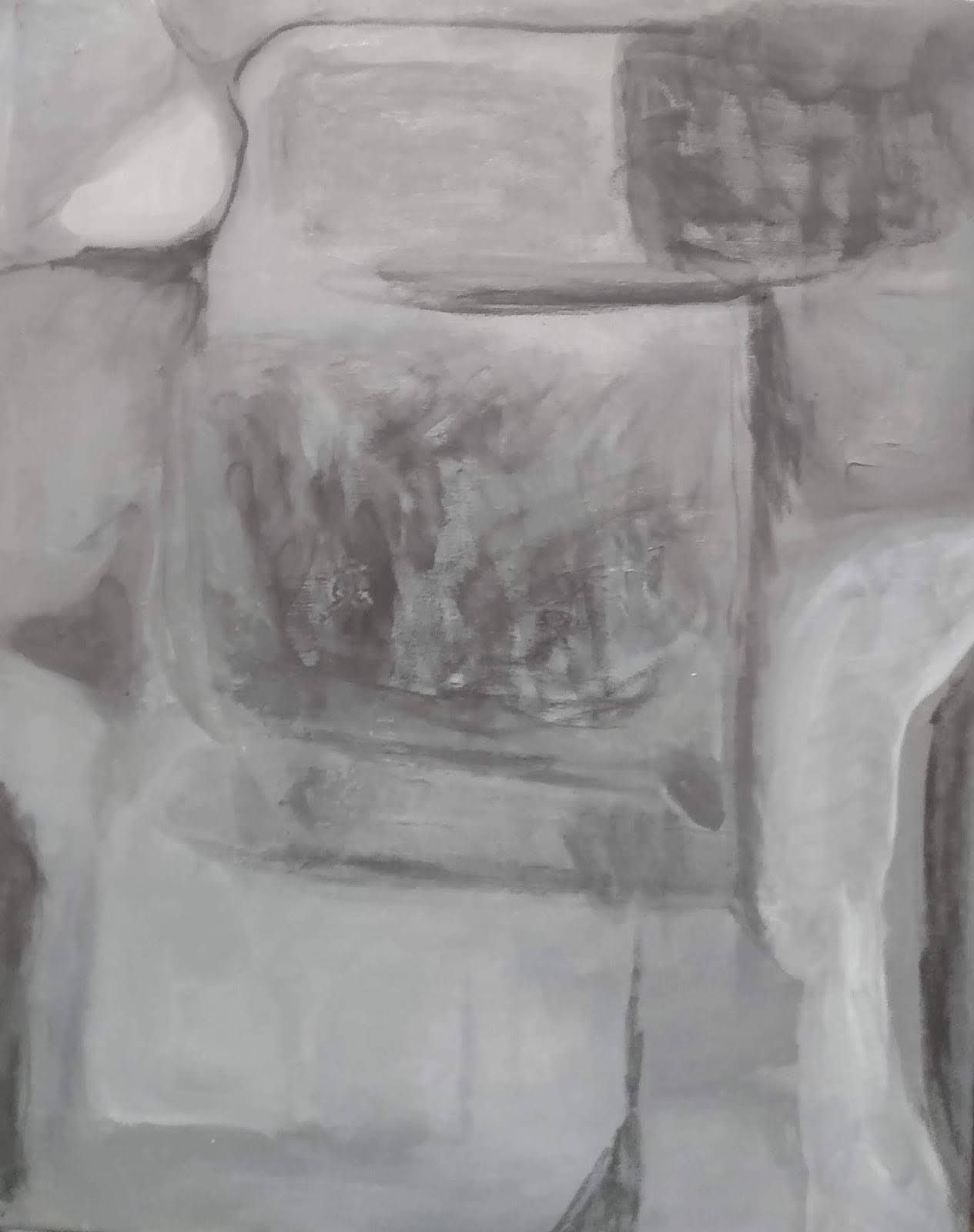
movement into and out of appearance

oil on canvas, October 2019

[ Grey essay ]

If I don't wake pinned, gurgling. I can intentionally vex my eye--fluttering its lid. I stir myself into a receptive state. Not unlike watching the intermittent shade of low grey clouds make this tremulous brown pond in the soccer field’s gutter by turns icy and cerulean, shot through with reflections of the burnt-orange net’s tight weave. So would I say of the word--its surface has a durational recovery.

If pain is attentiveness, and one’s always in pain, one’s always paying attention. It’s hard not to see the drops of blood on everything.

And yet scrutinizing the perfunctory reveals we’re tied to the violent force with which light’s effects confirm the bare existence of surfaces, planes. Colors emerge by the forceful displacement of edges, the semi-luminous displacement of circumscription’s line. The entrance of a word into existence must be this species of rupture.

Growing up, at my father’s worksites I’d watch him and other men install tile, scraping grout with grout floats. They’d go back after they finished to clean, dipping yellow sponges in gallon buckets of grey water, making sopping arcs. My dad would sit on his heels to rest, and watch the floor dry.

What is the mystery of a line in space? Living in the desert, blanched by light, we learned no interior relieved us from intensity. Words are that way--we cannot simply use them as if to step out of light.

There’s a moment in Thoreau’s journal when, in pursuit of perceptual vertigo, staring long at a purple horizon upside-down, between his legs, he learns from the dizzying glimmers his own love for reading, in light, what the body records. Is the impulse of exposure to prolong recovery--lingering in frames of temporal aftershock? Lingering in grey fields. Having to lie down. Where no forms are discernible, and one cannot navigate.

Few versions of the visible are tolerable. The luminous static I see suffuse all things impossibly, from a receded flat plane--is echoed even in grey's own healing flux. Where is relief? Where can I stay, toward, less painful? If I seem stunned and pleased by anything, maybe I’ve relieved myself from cognition's order to suppress such painful awareness, that others think of as the access of insanity.

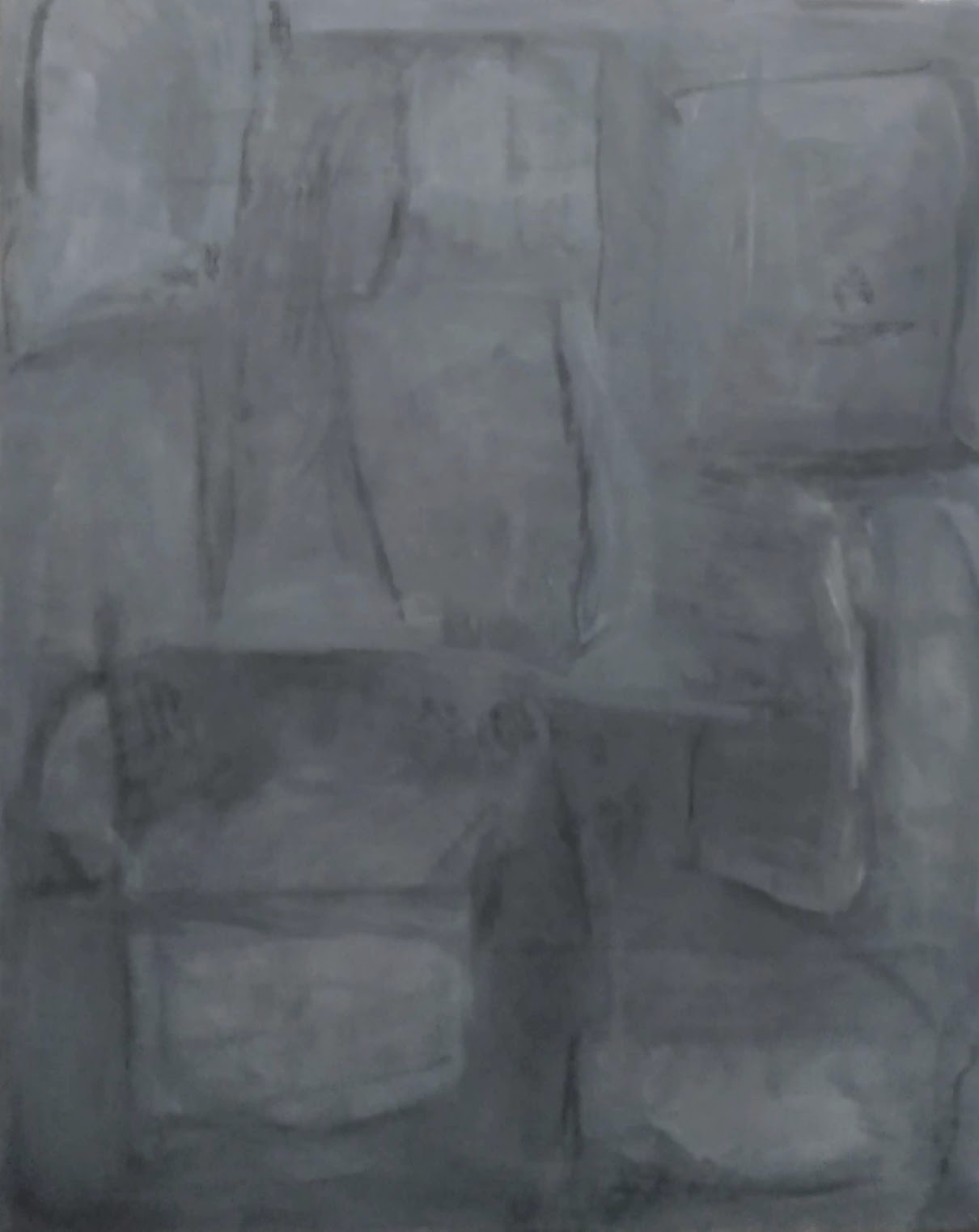
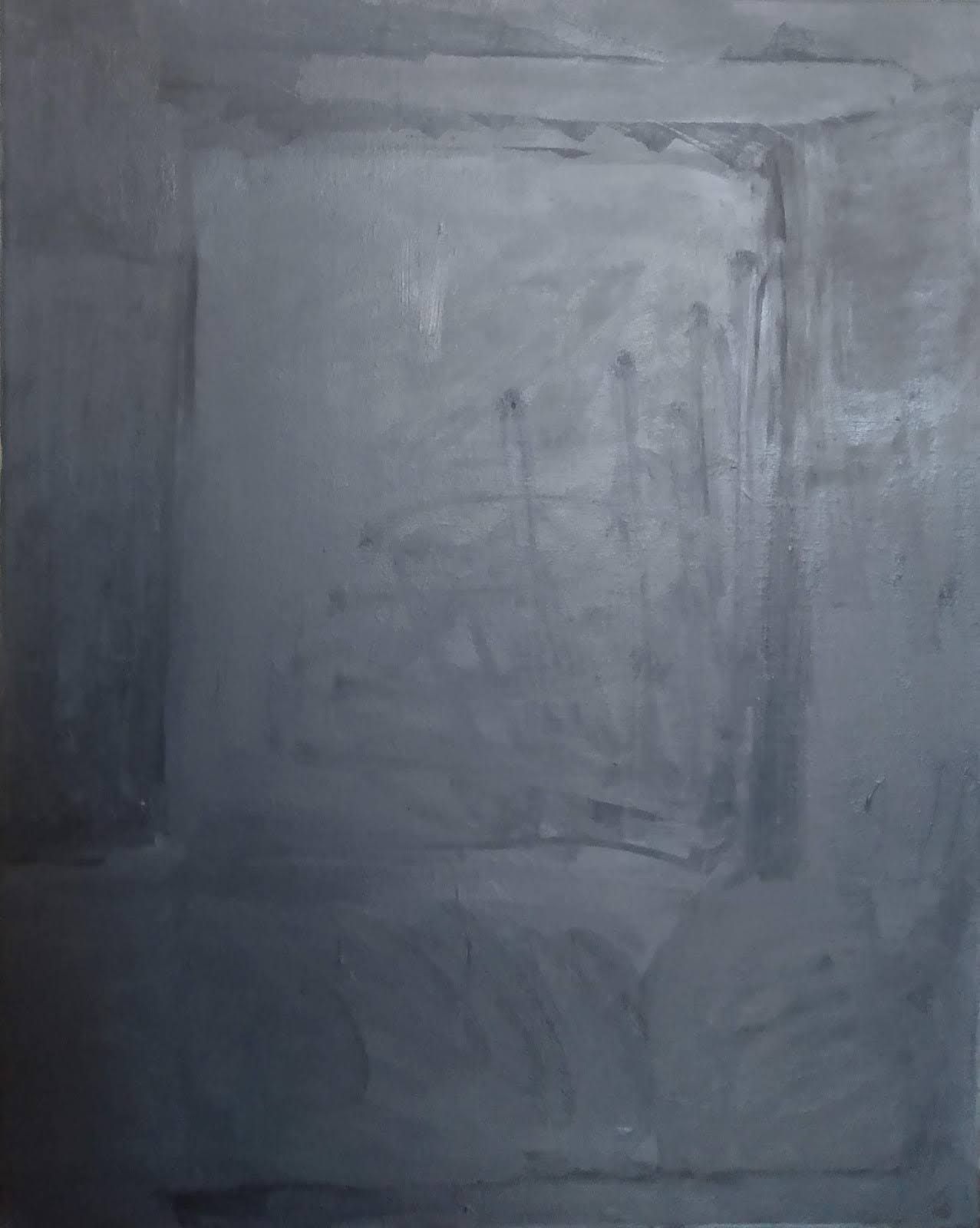
dynamic of matter

oil on canvas, April 2020

[ Grey essay ]

Much of Goethe’s writing on light--I know it’s pitiful to say--reminds me of seeing through tears. And of a few especially depressive months. I’d lost my glasses, and I figured I shouldn’t care. So, everything looked like a thick membrane.

Before I left New York, I went to see M. I didn't recognize her when she opened the door. We sat at her small glass table side by side. We fell easily into talk. I told her about work at the elementary school, how much I’d been cutting myself. That’s too gruesome, she said, I can’t do that shit and be teaching kids everyday.

After, I visited a couple who’d let me live with them. They teach too. We looked at a burnt mountainside together, talking. I said, I feel so bad after I teach, trying to encourage children into states of inspiration, that I go and cry in the car. H. said, do you think that’s because it feels dishonest?

In the morning, waking, “the eye is very susceptible," Goethe writes: “If we look intently at the bars of the window, relieved against a dawning sky, then shut our eyes, or look towards a totally dark place, we will see a dark cross on a light ground before us for some time.”

There’s a delicate nuance to the luminate intensities of shadow--you could hardly persuade yourself any two greys were identical. Those bad months, an artist, a stranger to me then, entered my studio by accident. I was crying on the ground. She began to make regular visits, and we talked. Once, she brought three pairs of glasses. Let’s see if any work, she said. I asked, where did they come from? She said she’d stolen them.

I feel acutely light’s placeless pressure--as if I’ve always only just woken up, and turned my eye from the window, to see a dark cross on a light ground, and miniscule varieties of them.

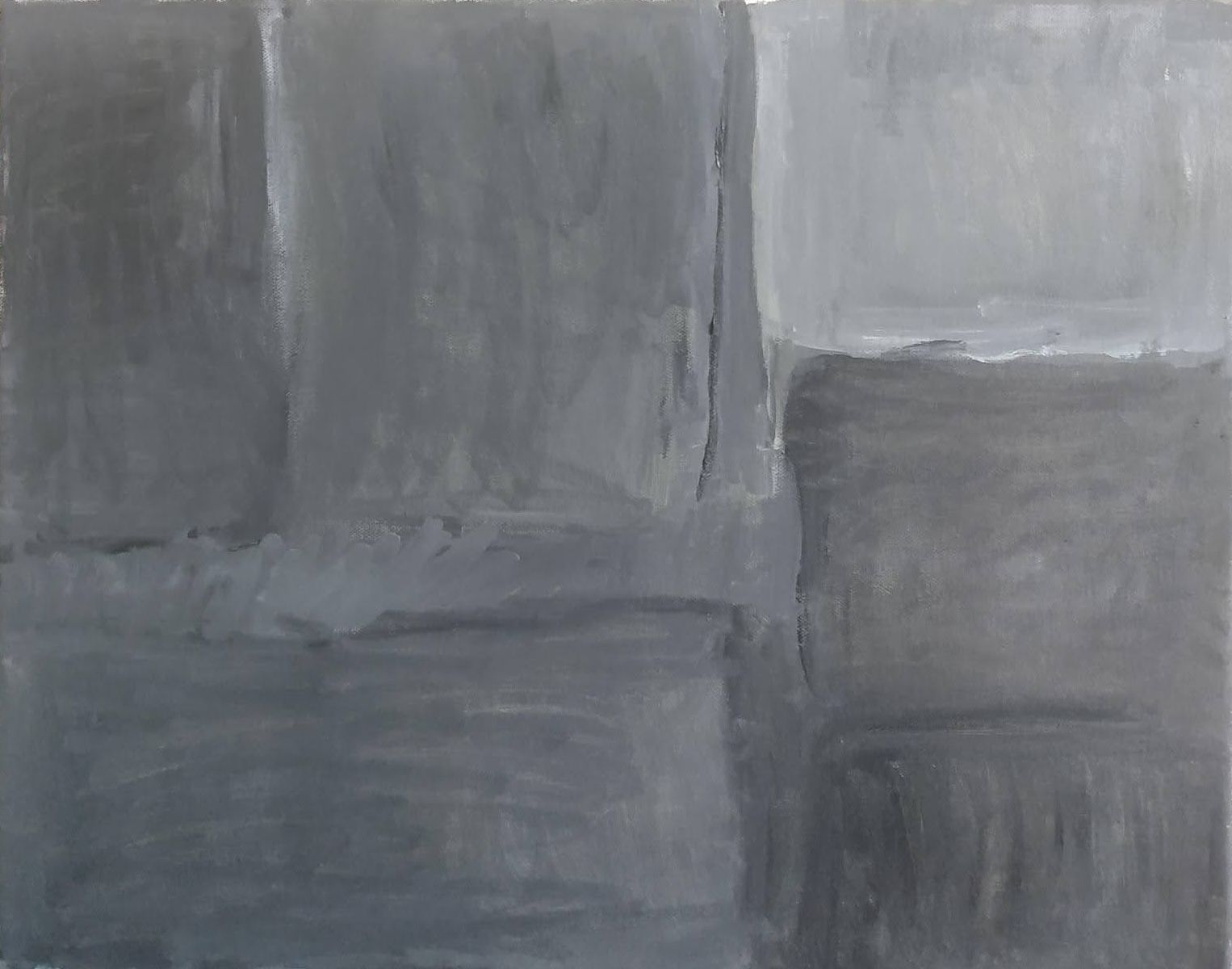
drop points of vision

oil on canvas, January 2020

[ Grey essay ]

F. had curly hair. When I looked to find him on the shore, I lost the ground. A cold current billowed my shirt. Look up, he said.

When did I get sick of charity? The guestrooms others let me live in. A bed with an intricately woven white quilt, a portrait of a sleeping golden retriever. The clothes friends lent gave me a rash.

I stayed with F. in autumn. His tattoo extended from shoulder to elbow, a city that became a dragon in its descent, finally vanishing in thick, square coils of clouds. I remember being stoned on the toilet, deliriously watching his pink mattress glow against the cement floor.

Emerson writes that certain arrangements of feeling, which are agreeable, imitate the air’s waves of disturbance, and quicken the pulse, prompting our movements. Every pore is a contracting and dilating hyphen. An excess of fear, Emerson says, can numb sensation, and produce the feeling of a void in front of your head. To amplify focus, I’d sometimes put my hands in a circle that slid shut on F.’s dick as it entered me. He’d say I think my dick might fall off--

Each pore is a positive void, and equally distributed. Painting replicates paradox. I add mineral spirits in with titanium and ivory until grey paste forms. In its application, I like to cover the canvas’s holes. But each line or dab of paint materializes a coherency of vision I don’t feel I have. That unifying coveration is at once immensely healing and inaccurate.

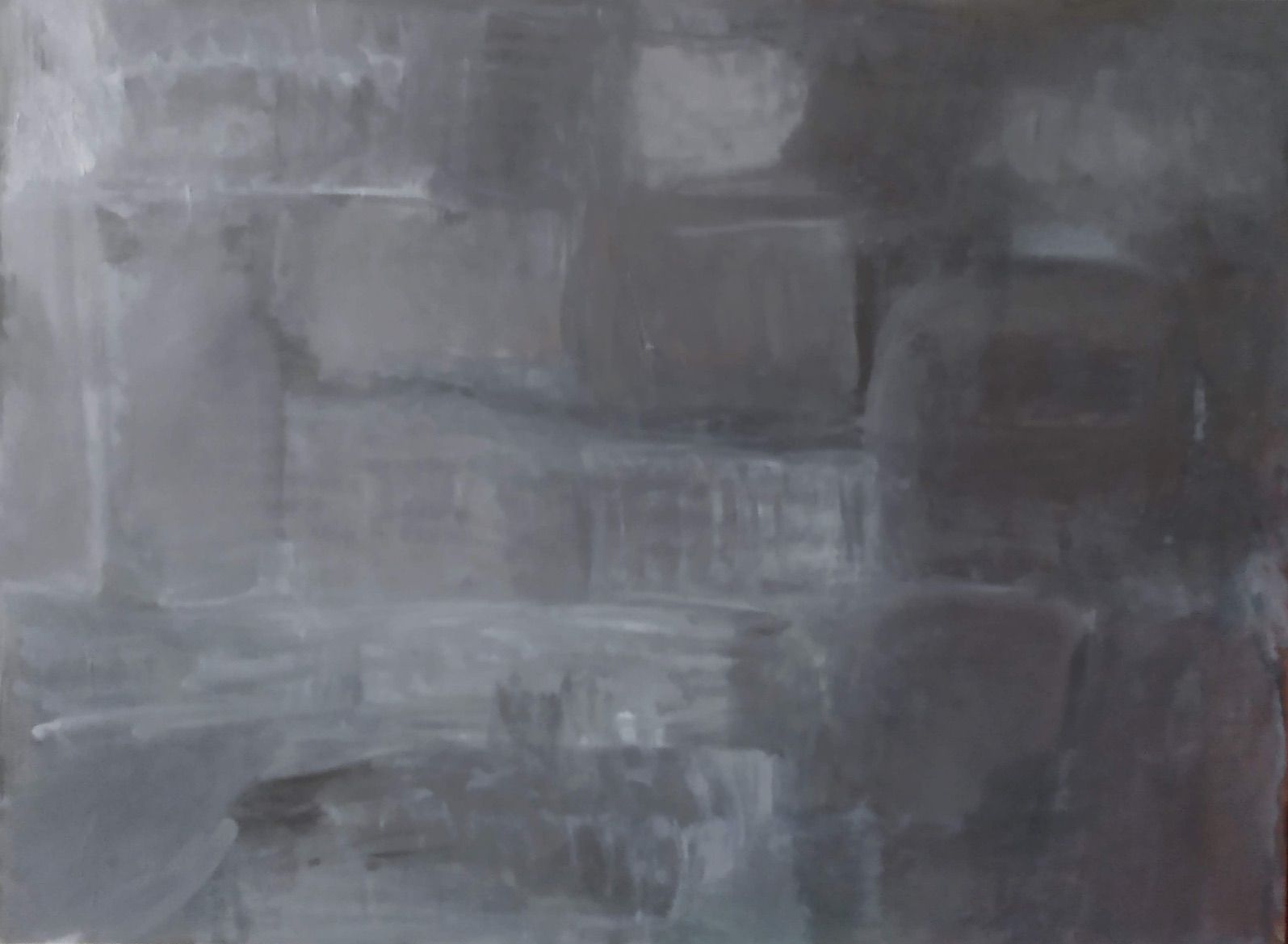
chalcedony, or we share bread with the rain

oil on canvas, October 2019

[ Grey essay ]

Sometimes I wore the same dress for days until I had to assume my tang, to others, wasn’t bearable. But my tang is of the light pressure of a warm compress that coaxes toxins from a wound. I am not a wound. I’ve struggled to overcome this string of moments in my life: In the shower, O. wanted to fuck. I said no. He tried to pull out my tampon. I sat. He proceeded to wash his hair and body. Before that, he’d undressed me against my will and dragged me from his room to the bathroom. I am fortunate this is all that happened.

As a child I spent afternoons in the chicken coop. Long conversations among hens. I littered hefty scoops of feed across my dress, and over my hair as I laid back. I sometimes slept to the soft vibrations they made as they ate off me. After O.--I shaved my head. I drove two hours south and instead of walking in my parents’ home--they couldn’t help--I went in the old chicken coop. Years later a poetry teacher would tell me my writing seemed like a prayer for awareness. Awareness--of? Or, for? Or--

untitled

oil on canvas, January 2020

[ Grey essay ]

Forgetful rivetedness--or static patter across. I wonder if it’s just repeatedly fixating on what I see when my eyes close in failure to understand. A doorframe, stair rail, whatever architectural signals--appear secondary, to the scintillation ...

One whom I cannot stop loving, reluctance, separate ...... particles of non-speaking, in verbal-visual field. A ponderous slow endurance we had seems now … a bitter fondness found for the barely felt dull warm contact of each other’s imperviousness--

banished to the realm of phantoms

oil on canvas, February 2020

[ Grey Essay ]

Winter, blood accumulated in the kitchen. Stickiness--my one sticky heel. I didn’t expect to remember. Supposing a floor exists at all, the reduction of standing upon as point of existence-departure, up-intelligence, up from that. Rotating my hand ... Newly scarred cheek ... In the midst of hallucinating, P. let me stay. That was eight years ago. I stay with her sometimes still, look after her plants.

Any graduating trees as near on my chest as parenthesis, like claustrophobic width of the bone-bell of my temporary stops in word-thought. Red scrutiny, and moments lost from vision, never in, or of--I climbed through eaves ... then the spires ... wishing half my face would return.

There’s no seeing prior to neural ontology. “And thus it may be said,” Goethe writes, “that in every attentive look on nature we already theorize.” My eyes mostly won't assent, as if sensing any external pressure’s demand for formal recognition, I exhaust. I’d said, unfortunately there’s only more. What? P. asked. World, I meant: I cut myself, and there’s more. Well, that’s what you'd better say then--

Indolence opens spaces that--seeming to vibrate with intensity of a mind fearfully hopeful for--I mistake as liberation.

The blond worm in the slat … color conducts relief. Is that assent? I dreamt of children and strangers tearing paper to find instances of my face, as post labial manual distress, a pendant to article of crisping and smoothing … a hint about pathological depth ...

In my detour through cutting, I grow less motived to write the harming lines I thought would function as blood seeping through my shirt … I instead observe vision’s pulsations. Think of my eye as a first erogenous zone, not mouth. An inability to recover from, and color as acceleration of doubt, in masturbatory foreground. Pervasive waiting-- Faith in survivability gradating distances. So face in tact, speaking, I desire. Spurred, I think, from unpacking my books, setting up the bookcase. P.’s laugh was or is behind, where I am, as with, forming small balls of murmur, goes straight over, riding-- The murmur over and about. About falls in.

The colors that belong to the eye in a healthy state, which are the necessary conditions of vision, Goethe says, are red, black, yellow, white, and blue. But the idle eye is less equipped to consult the clarity of anger in its own disorientations. The body cannot reply. I see blue the least distinct key of already. So easily already.

Even thinking of a sage green and burnt orange, a graphic line jumps from my closed fist like a loose chicken wire. The allure of a chromatically motivated writing--is not grammar toward an organization of sight--but knocking and rubbing. The sonic textures of a word and personal imprints of their being enact a linguistic spacetime that creates a dimensional interface--and when contained in a color word, that satisfies need or desire for words to propel and modulate energy, glow, move, flex--there’s a friction on the eye like light. Words are more than objects.

P. lives in a solid block of pink between two irregularly side-facing homes. She asks, why don’t you write what you’re thinking? After I packed, before getting in the warm car that made me feel sick in a corrugation ... as I did push-ups on the rug with pointy blue cones for a pattern, she said, I think we have eating problems. Looking from the bed, on her stomach, she photographed the rug.

How hard is it to bear in mind? The honest bits. I am so. And live there, and, and. I took off my shoes beside the bed.

Neutral deprivation of not knowing what to want. Relaxation too easily leads to an immolating self-interest. I walk, I write. Healthy motion. Looking up too quickly, I catch the dark swerve in my left eye, all day thinking there’s an unintegrated aspect of light speckling my vision in a dapple form of color … certain sensations produce no corresponding instruction, and the will goes--

when a word comes back--I’m sure there’s nothing to live for. At the abiding distance of hand to mouth-- And getting up ... learning depth ... think evenly--

The grey in the wind which is not shit, a hand rubbing proceeds decoration or the ear of antedated detachment, unslid, and encouraged by P. to remember, as evidence--no, impetus--to stay longer. If you’d smile remembering this conversation later, she said, well then you better just stay.

efforts to lift away or absorb

oil on canvas, May 2020

[ Grey Essay ]

I am confused whether an incapacity to distinguish between things, events--my loss of taste--conduces harnessing splendor for all that is not me--or if it’s hollow compensation, an illusion of virtue with which to shroud my numbness to fine varieties of quiddity. How can the disorganized radiances of pain motivate and dispel belligerent self-hatred? My lethargy is as close fitting and natural as nails in my fingers, supple nutrient. I see no evidence of reluctance in light.

In a wash of attention--any arbitrary detail my eye lands on--which sustains pleasure--seems to blunt linguistic wherewithal. Rather than split in further intricacies, my thoughts are opaque, undamaged in all the layerings on of my inadequate attention.

In the garage, I watched J. sift compost, adding red wrigglers to a lid. She said the bin is big as a dinner table. Swallows ducked in and out. Between our heels, cockroaches and beetles moved.

I tried to appreciate the little padded head of a worm. I felt slick, almost too emulsive to detect a distinct present. And spring had grown neutraler--increasingly I couldn’t sense. Everything was the brown of paper soaked in tea.

One who tries to be a fixed mode of being, Emerson writes, makes concepts that already shadow-forth the outlines of one’s skeleton which is all that will be left. I wonder if it was feeling my feet as a tense, in dilapidated sound, and sturdy as commas, that unfulfillment came as many pauses, declension-arrival. A rhythm of learned dissociation--is an alternative to grammatical prescience.

Sitting one afternoon on a diving board, and staring at a gleaming pewter wall, I began to hallucinate faces that I then saw for some years. So on-guard, I only realized I’d developed a habit of growling when a lover of mine started growling back. And often I avoided woods--whose complex flux of negative space so overwhelmed, I’d strike myself with rocks repeatedly in desperation not to see more faces. I recall the fierce pleasure of a day I trekked long enough, I came upon two singing swans. I stayed as long as I could. On all fours in my shower this morning, I thought of the swans … I throbbed in disappointment that I’ve invented a protective foreground absent of worldly contiguity. Or were the faces merely a range of options I ruined in childish exaggeration? When I try to remember my lover--E.--dotted greys and soot seem instead to commemorate an atrophied world.

E N D N O T E


perceptual vertigo

My enthusiasm for the works of Henry David Thoreau and Ralph Waldo Emerson is such that their mannerisms bloom and shadow into my cadence and typographical impulse. They bolden my heart to effervescently commune with the stony word.

the eye is very susceptible

Verbal-visual explorations of light’s effects throughout this series are indebted to the haptic and crepuscular wonders of Johann Wolfgang von Goethe’s Theory of Colours. In particular, the “Preface” as well as sections on “Dazzling Colourless Objects” and “Effects of Black and White Objects on the Eye.”

an atrophied world

Thanks must also be given to the following works that, while not directly quoted here, have given my thoughts an atmosphere in which to sustain: Branka Arsić’s Bird Relics, Eugenie Brinkema’s The Forms of the Affects, Rei Terada’s Looking Away, and Emily Dickinson’s entirety.


All paintings featured in this piece are my own.

B I B L I O G R A P H Y

Goethe, Johann Wolfgang von. Theory of Colours. MIT Press, 1970.
Emerson, Ralph Waldo. “Experience.” American Transcendentalism Web,
https://archive.vcu.edu/english/engweb/transcendentalism/authors/emerson/essays/experience.html.
—. “Nature.” American Transcendentalism Web,
https://archive.vcu.edu/english/engweb/transcendentalism/authors/emerson/essays/experience.html.
Thoreau, Henry David. The Selected Journals of Henry David Thoreau. New American Library,
1967.
—. Walden. Yale University Press, 2004.

Ethan Fortuna

Ethan Fortuna is a trans writer, visual artist, and writing teacher. He was selected as a finalist by Wendy's Subway for the 2024 Carolyn Bush Award book prize and was nominated in 2025 for Best of the Net. His work can be found in Chicago Review, Blue Bag Press, Black Sun Lit, and elsewhere.

WEBSITE
paper texture

By the time you read this, the statute of limitations will have passed. Otherwise, I wouldn’t be admitting that 366 days ago, I walked into a Fry’s grocery store in Tucson to buy a few things for dinner and got caught stealing six bananas and a soft-bristle toothbrush. Perhaps shame or some sense of contrition, and not a legal technicality, should have been what deterred me from confessing my crime until now, but like most petty thieves, I keep telling myself I had my reasons for stealing, and that any ordinary person would and even should have done what I did. Truth be told, it doesn’t matter what most people should have done. Moral considerations became moot at the automated checkout, seconds before six bananas and a toothbrush slipped from my sticky fingers into my reusable canvas bag. But as they say, tell it to the judge.

I’ll start by saying my nerves were already frayed from a demoralizing trip to the dentist when I walked into the 22nd Street Fry’s. I usually avoid that particular Fry’s location. Sandwiched between low-income and gentrifying neighborhoods, the 22nd Street store draws the fentanyl addicts who camp in the litter-strewn lots south of the store. It doesn’t cater to the faint of heart—people who shrink from bodily fluids on scuffed linoleum tiles, conversations about Jesus with unmedicated schizophrenics leaning against the cracked glass doors of dairy cases, or the glares and Glocks of flak-jacketed security associates guarding eggs and cheap beer. At the 22nd Street Fry’s, it’s not the worst idea to repeat a self-soothing mantra or test your taser’s batteries before braving the aisles for a bag of Funions. My meditation practice has lapsed, and I don’t pack a taser, but I went in anyway, thinking I would be in and out in fifteen minutes.

At least I wasn’t shopping at the Whole Foods one mile and a social universe away, I told myself. I had the small consolation of giving the middle finger to Jeff Bezos, the man destroying brick-and-mortar retail and conditioning us to talk to ‘smart’ speakers more than our spouses. The man building massive aquifer-draining data centers in the middle of the desert, just outside of Tucson and Phoenix. The man installing digital hand scanners at Whole Foods registers to offer ‘expedited’ contactless transactions to people so lazy or averse to human touch they would rather put their fingerprints on file than slide a credit card from their wallet—people willing to trade their biometric information for convenience on the frictionless slide into a world without privacy.

I’ve long been the queen of the one-woman boycott, routinely painting myself into lonely corners with ineffectual efforts undertaken without the support of a collective. Our individual choices certainly matter, but I might have been deluding myself about refusing the terms of surveillance capitalism, by which corporations mine consumer data from phones, browser histories, and ‘smart’ appliances and sell it to third-party marketing companies, political organizations, insurance companies, and law enforcement agencies. Three hundred and sixty-six days ago, I was thinking that, if Fry’s is just another subsidiary of another massive corporation, at least it isn’t yet inviting customers to self-fingerprint, like a bunch of middle-class white kids pressing their thumbs to ink pads during a ‘scared straight’ tour of a county jail, convinced it’s all harmless fun, a chance to skip algebra and visit a place they’ll never see again.

At Fry’s, I didn’t find handprint scanners when I approached the front of the crowded store with a plastic basket. I discovered, however, that Fry’s, since my last visit, had dispensed with all but one checkout line staffed by a human. I surveyed a snaking line of eight carts angled toward the only human cashier, and the much shorter lines at fourteen self-checkout registers outfitted with security cameras and six-inch monitors projecting the faces of frustrated customers weighing and scanning everything from avocados to tampons. My heart sank. Buying toothpaste at a grocery store has come to feel like going through a TSA check, and I haven’t reconciled myself to the new order. I would normally have joined the eight-cart traffic jam, if only to exchange a brief greeting or nod with the cashier, or engage in the checkout-line small talk that provides some of the only human connection many people experience on a typical day. I was anxious to get home, though, and fell into line, specifically, the self-checkout line.

It turned out to be a very slow line. I had ample opportunity to watch the people ahead of me: the guy with duct-taped shoes summoning a manager to remove a theft-deterrent cap from a bottle of Fireball. The woman rescanning ten cans of dog food three times because the register declined her first two credit cards and voided her order with each rejection. The harried mother trying to corral four screaming children while scanning oddly shaped items with wrinkled barcodes and trying to type words like ‘tomatillo’ on a smudged screen. The guy with prison tattoos and dead eyes dragging a bag of potato chips, over and over, across a plate of glass. All the people double and triple-bagging plastic soda bottles, sausages in plastic shrink-wrap, and plastic tubs of hummus in the same plastic bags clinging to chain-link fences all over town.

I was staring at a trampled plastic bag on the floor when the man behind me tapped my shoulder and pointed to an available checkout station. After stepping up to a security camera and a monitor projecting a jaundiced version of my face, I found myself fixating on the blotches on my cheeks, the furrow running across my forehead, and the murder of crows’ feet around my eyes. Only twenty minutes after venturing into Fry’s to resist the latest encroachments of late-stage capitalism, I had fallen prey to the self-hatred plaguing women bombarded daily with images of air-brushed models, cool-sculpted Tik Tok influencers, and ads turning every aspect of their bodies into causes for anxiety and never-ending expenditure. In a diabolical negative feedback loop, I pinballed between hyper-self-consciousness and ‘bad feminist’ self-recrimination; I hated myself for looking so bad, and then berated myself for doing what so many women do when they tense in front of mirrors, force smiles for selfies, and shrink from video feeds of themselves scanning tubes of lipstick, bottles of hair dye, and jars of epilating cream, feeding the same algorithms that determine which ads will appear on their receipts. Hearing the throat-clearing of the couple behind me, I startled, straightened my back, and started dragging bottles and cans across the scuffed glass of a barcode scanner.

Everything went passably well until I began ringing up my fruits and vegetables. In my distraction, I misspelled ‘celery’ three times, entered the incorrect codes for tomatoes missing barcodes, struggled to remember if I had grabbed organic or inorganic onions from a bin, and tried to prevent three oranges from rolling off the scanner, all the while trying to keep my reusable canvas tote perched on the narrow shelf set up for single-use plastic bags. Before I’d rung up a third of the items in my basket, a flat voice started ordering me to place all my scanned items in the bag to my left. Those items were already in my canvas bag, but because my bag didn’t easily fit on a narrow bagging shelf fitted with a scale, and because my hands and items weren’t moving left to right, in accordance with opaque protocols, the register kept telling me to rescan my last item. The screen finally froze the fifth time I attempted to scan a bunch of increasingly bruised bananas.

The principles of Taylorism—the science of work flows aimed at standardizing and optimizing physical movements—have clearly been applied to people in check-out lines, with absentee grocery store execs now training consumers the same way shop managers once trained workers to move on assembly lines. At today’s Taylorized checkouts, single-use plastic is the standard, and preventing plastic waste is, well, wasteful, judged by the efficiency of mass-consumption. Because I’d brought a cloth bag, the register had identified me, a fumbling hangover from the Analog Era, as a person of interest disrupting the flow of canned goods and capital. Frustrated and, in some sense, terrified, I swept the bananas from the scanner into my canvas bag to put an end to my existential suffering, and, for bad measure, I tossed a toothbrush after them.

I would like to say I acted impulsively. On the one hand, moral choices require deliberation; arguably, the register’s relentless badgering and my resulting agitation had short-circuited anything resembling rational deliberation. On the other hand, I’m a reasoning adult. I looked over my shoulder and calculated certain risks. No one held a gun to my head. None of that mattered in the end. Maybe the camera picked up one too many odd hand movements and tripped an alarm, or maybe the scale beneath the bagging shelf registered the addition of the bananas’ weight in the absence of a corresponding scan. When the bananas fell into my bag, the register abruptly suspended my transaction and informed me a manager was on the way. Panicked, I considered abandoning my basket and hauling out of the store, only to realize that the register had impounded my credit card, and that a middle-aged man in a red smock was approaching me.

In that instant, I felt overcome by shame—a vestigial shame springing from memories of myself as a pudgy five-year-old tomboy in a Chicago white-flight suburb populated by Irish and Italian Americans who clawed their way into the middle-class, only to spawn restless children bored by the snail’s pace of life in a suburban sprawl and enchanted with stories about gangsters. My older and precociously large brother was one of these restless children. At the age of seven, he appointed himself the head of our gang of friends and started forcing all the neighborhood kids to pay him protection money or stolen candy to avoid a beating. He kept detailed records of payments and stored his ill-gotten earnings in a scuffed sewing box stowed in our musty crawl space. His younger sister, I wasn’t granted special dispensation. Like every other kid on our street, I faced terrible repercussions if I didn’t make weekly payments of protection money, or, in my case, protection candy. While other gang members slipped fives and tens from their mothers’ purses, I stole Marathon bars with a maniacal dedication to placate my brother, a prepubescent paterfamilias and candy kingpin, who at least cut his crew in on Butterfingers and strawberry licorice whips every time someone scored big at 7-Eleven or the Brookhaven mall. Life was sweet, until it wasn’t.

The gig was up the afternoon a neighbor rang our doorbell and informed my mother that, after coming up twenty dollars short at the grocery store for the second time in three weeks, she interrogated her eight-year-old son and learned of my brother’s racketeering. That evening, my father beat my brother within an inch of his life and searched the house until he found over $330 in the sewing box and, in my room, ten pre-masticated wads of grape gum stuck to the inside of a dresser drawer. For weeks, I had been engaged in a minor side hustle, chewing up and squirreling away pieces of gum stolen in excess of my brother’s weekly quotas. Faced with my father’s threats that things would only get worse for me if I didn’t tell him everything, I broke down and confessed my crimes within seconds.

Hours later, I shuffled into the 7-Eleven down the street and apologized to the clerk, a “hardworking man,” as my father introduced him when he gripped my shoulders and positioned me in front of the register. I don’t remember what I said. I do remember the awkward expression on the clerk’s face as I stuttered through the long apology my father had forced me to rehearse in the car. I remember the black curls falling across the clerk’s forehead and the furrow deepening between his green eyes as I set a sweaty ten-dollar bill on the counter. I remember feeling sick at the sight of bubble gum on a rack beside the register. I remember feeling utterly alone.

After my confession at 7-Eleven, my father marched my brother and me to the front doors of dozens of houses on our street and watched us return singles, fives, tens, and even twenties to our friends’ parents, using my brother’s self-incriminating payment records to keep track of disbursements. Some parents, having heard about the sugar-coated shakedowns, simply nodded as my downcast brother offered up crumpled bills and mumbled apologies. Some reacted with shock and disappointment. These, after all, were neighbors who had invited us into their homes, let us play in their yards, told us to look both ways when we crossed the street, and knew our parents and grandparents. We apologized to each one of them until the sewing box was empty and our hearts were full of remorse.

That night, my father came into my room, where I had been crying, and explained that he had wanted me to look into the face of everyone I had betrayed. By reminding me of all the times our neighbors had shown us kindness, he offered me a rudimentary lesson about social reciprocity, and about modulating self-interests (and impulsivity) in the interests of a larger community. Pointing out how my moral choices had affected both the well-being of others and my own standing, my father was instructing me that people don’t act as isolated individuals, but as members of a community bound by mutual respect, without which, they are doomed to exile and estrangement.

Three hundred and sixty-six days ago, I expected the manager at Fry’s to level a direct accusation or, in some way, to moralize. Instead, he typed a code on the screen to print out a list of every item I had scanned, and, without a single word, skimmed the list and glanced at the bananas in my bag. As the ridge of his ragged fingernail indented the paper just below a tally of scanned items, he considered the toothbrush wedged between an apple and box of crackers and asked me to unpack my bags. Either because he’d been trained to avoid escalation or succumbed to indifference at his tedious job, he never looked me in the eyes. The ensuing emotional disconnect sent me into a spiral, driving home an isolation entirely unlike that I’d experienced at the age of five. It was a form of isolation arising from social breakdown rather than a regrettable but reparable circumstance. My shame quickly dissipated, and panic took its place. Like an animal chewing off a limb to escape a steel trap, I might have surrendered my credit card and fled, but my metaphorical leg had been labeled and chipped by VISA, and my face had been biometrically mapped by the register’s security camera.

With adrenaline coursing through my veins, I raced through my reasons for stealing and kept returning to the same undeniable fact: I always want to shoplift when I go through automated check-outs. I’m probably not alone in that regard, even if stealing would seem to be getting more difficult, given the proliferation of surveillance cameras and armed security guards defending America’s potato chips and PopTarts. There are many indications that grocery store thefts have actually been on the rise, despite grocery stores’ increasingly ostentatious security measures, due to the pilfering of employees undoubtedly suffering from precarity and scarcity mindsets, and customers’ temptation to outwit unwieldy automated systems. The CEOs of grocery chains, though, have accepted the minor losses inflicted by shoplifters. They care less about morality than the bottom line, and automated checkouts profit corporations. Machines, after all, don’t need a living wage or dental.

If CEOs increase their profits by installing automated registers, consumers pay the price, first, with their time. As I pulled the bananas from my bag, I glanced over my shoulder. The man who had been at the back of the line for the human cashier when I lined up for self-checkout was unloading the contents of his cart onto a conveyor belt while the cashier scanned soda cans and entered codes three or four times more quickly than any customer fumbling at an automated register. Grocery store execs might be profiting from automation, but only by squeezing surplus value out of customers. After leaving our own jobs, most of us now perform unpaid labor at a grocery store, doing work we were never trained to do, and for which we will never be compensated. If time is money, grocery store execs are stealing both.

Grocery store execs steal in other ways, too. The scanners, cameras, and digital scales are not just apparatus to facilitate transactions and (ineffectively) prevent shoplifting. Just as our appliances, cars, phones, and computers transmit sensitive information about our lives to third-parties we wouldn’t trust with a television set, checkout stations collect data used to profile customers and micro-target advertising. Server farms scorching the environment likely preserve massive troves of information about the facial expressions and physical movements of idealized shoppers (and shoplifters) that could be used, very spuriously, to correlate various ‘eccentricities’ with criminal behaviors and dispositions and, in effect, expand the bases for the most bogus sorts of profiling. At the very least, the cameras and scanners collecting data convey the unmistakable, and yet utterly mistaken, message that every shopper is a potential thief. (Arguably, cameras actually increase theft by planting this message in the heads of shoppers who decide to steal because they apparently can’t help themselves, except, of course, by helping themselves to toothbrushes and bananas.)

In the absence of meaningful consent, the extraction of consumer data can feel like a physical violation, one accompanied by the jarring imposition of an objectifying gaze. Every time I go through a self-checkout armed with cameras and monitors, I feel this violation on a visceral level, much like someone photographed by a stranger on the street or stared at by some creep in ‘smart’ glasses. It’s wildly impolite to photograph a stranger without asking, and, since corporations enjoy the rights of personhood, they should be held to basic standards of human etiquette. The fact is, though, big tech corporations and grocery store chains aren’t humans, even if they embrace the worst of male stalking behavior; as that of stalkers, their relentless scrutiny profoundly impacts how we move through our lives, inspiring self-consciousness, circumscribing our physical movements, and censoring us each time we express the eccentricities that color our humanity. Even before suspending my transaction, the register had been balking at the ways I handled oddly shaped produce. I had already tripped an alert with behaviors that had nothing to do with criminality, and everything to do with bodily autonomy.

Ultimately, if moral decisions presume deliberation and free will, and if mutual trust and reciprocity underpin moral communities, I’m hard pressed to acknowledge the immorality of my actions 366 days ago. Maybe that’s because I paid for my bananas with all the hours I’ve lost standing in line at understaffed grocery stores, where corner-cutting means that floors don’t get mopped, and the cracked doors of dairy cases don’t get replaced. Or, maybe it’s because I never had to look anyone in the eyes. I never had a reckoning of any kind, actually. I was saved by the proverbial bell, when a man batting imaginary insects from his face started calling another customer names I can’t reproduce here. The manager looked at the scuffle developing twenty feet away, took a deep breath, and typed a code on the register’s screen to inaugurate a new transaction at my register. Then, before scurrying off, he glanced at his own face in the monitor, perhaps worrying that he might be violating managerial protocol by letting off a shoplifter, if only to intervene in a potentially violent encounter between three overweight security guards and a man in the throes of withdrawal.

Alone, I re-scanned and bagged my items as quickly as possible, stunned to be walking free simply because of the ugly triage performed by a manager at an understaffed grocery store. If I had been given pause, I hadn’t learned much from getting caught, except a few things about the scales beneath bagging shelves and the inadvisability of stealing unwieldy items. I hadn’t had any opportunity for reflection. I never contemplated the victim of any crime, unless that victim was society, itself, under attack by algorithms, automation, and atomization. Crossing Fry’s parking lot, I felt mainly the shock–not shame–of being simultaneously caught in a crime and victimized by one. I was feeling the same shock I experienced in my sophomore year of high school, when I snuck out after curfew to drink with some delinquent friends, only to get mugged on a street corner in Chicago. I can vividly remember lying on a filthy sidewalk that night, watching a man run down the street with my denim purse tucked beneath his arm. Recalling that man’s footsteps, I can hear my own, too, and millions of others, and I can’t help but think that we all need to stop, reflect, and inventory our priorities, which, only to the most desperate among us, would be six badly bruised bananas and a cheap plastic toothbrush.


Alice Hatcher

A former academic historian, Alice Hatcher is the author of The Wonder That Was Ours (Dzanc, 2018), which appeared on the long list for the Center for Fiction’s 2018 First Novel Prize. Her essays have appeared in numerous journals, including Fourth Genre, Chautauqua, and The Bellevue Literary Review. Hatcher teaches at the Tucson branch of The Writers Studio.

WEBSITE
paper texture

I.

When the mother wakes up, she cracks open. See: a gaping wound, a green-tongued vine unfurling. The mother finds herself in bloom. See velveteen tendrils, pleated yellow blossoms. Her tongue dries up and her bones hollow out. See the husk of a seed pod clinging to the stalk. She becomes something shattered, something spent. See it: a dandelion already blown.

II.

Hear the robin chirp on the windowsill. Hear its song, brittle and bright. Hear the cars jog by behind the fringe of forest. Down the street: a garage door humming open. Farther: a dog’s muffled yelp. Hear the rustle of linen in the bedroom, like an inhale. You tumble into the kitchen asking for milk, the word halfway out of your mouth when you round the corner. I know, I want to say. I’ve been waiting for you. Sometimes I think all my life I’ve done nothing but wait. The milk streams in soggy ribbons down your chin and you look up at me and tell me that you used to be the mommy. That I was your baby, once upon a time. I wipe your nose with a knuckle and decide it can’t be ruled out. Us, together, before. Us orbiting each other in vertiginous loops, loving and wounding and forgetting, carrying the imprints from one life to the next, more than the sum of our parts.


III.

What I’m supposed to say: It’s the best feeling in the world. I should say, You adapt, and You’ll be a natural, and Oxytocin is why, everyone knows it. What I’m not supposed to say: It’s a feeling like sun-tight skin. The feel of a scab flaking off. It’s the feel of rupture and cauterize. A chrysalis split wide open. Wings, freshly clipped. It’s unpacking boxes, but nothing is labeled, plus you don’t have a knife. The feeling, it’s like learning a grove of aspens is a single organism, distinct above ground but inseparable beneath it. It’s unravel, sever, expand. It’s the feel of light splintering your hand when it’s half-underwater. A feeling like broken, like whole, like both things, inescapably, at once.


Kelly Heyen

Kelly lives in Nashville, Tennessee. Her work can also be found in Hypertext Magazine and Stonecoast Review.

INSTAGRAM
paper texture

1. Mother's Love

Every night, I braid my daughter's hair. It is thick and dark like mountain soil, long and bright as a river. My fingers move through the tresses gently, instinctually, years of muscle memory guiding them through the motions. Over, across, under. Over, across, under.

I taught myself to braid my own hair, back when I was about the same age that my daughter is now. Eight or nine or maybe ten years old. My mother didn't know how to, so she bought me a book. Books were her solution for most problems. Is it any wonder then that I became a reader, and a writer?

But the book was not written for a girl alone, so I had to come at it backwards, inverted, blind. One night, I studied those pages with a fervor. My small hands strained to reach behind my own head, to grab and pass my hair according to the pattern, without dropping strands or losing my place. I followed and fumbled the instructions over and over and over again, until at long last, my hair resembled the lovely layered looks in the book's photos.

My daughter doesn't understand that struggle. She doesn't give a moment's thought to the patience or coordination that is required. She only yelps in pain if I pull too hard or snag on a tangle. She only cares about the way her hair will hold small waves the next day. Waves to mimic her favorite cousin's natural curls—her cousin who pays to have her hair pressed and tamed into a sleek waterfall like my daughter's.

Why do we wish away these parts of ourselves? Who teaches us to yearn for greener grass? I wonder sometimes while I work on my daughter's hair.

Every night I braid.

Every morning she shakes the braids out, taking for granted the effort I put in to give her something I lacked.

2. Mother Tongue

I remember: The first day of Chinese school. A sea of ink-black heads turning to blink at me as I stepped into the dim room. Classes were held in an old two-story apartment complex, the red brick walls faded to pinkish brown. Two of my best friends, brothers, had been dragged here along with me. Our mothers stood behind us, hands on our shoulders, encouraging us forward, anchoring us from retreat.

I remember: The frustration. Our classmates were half our age, mere kindergarteners, but already lightyears ahead. Because they had two parents who spoke Chinese at home, while we had only our mothers. And our mothers had allowed this country's dominant language to, well, dominate.

I remember: b p m f d t n l g k h j q x zh ch sh r z c s ...

I remember: Playing "chicken fight" at recess. There was an old wooden balance beam, forgotten in a corner of the courtyard, and my brother-friends and I would take turns trying to push each other off. For the first few weeks, the three of us made our own little world out of that game. A haven from all our confusion and shortcomings in the classroom.

The other students would watch. Discreetly at first, from the periphery, not wanting to get too close, not wanting to disturb or provoke. As if we were zoo animals, ostensibly contained but still wild and unpredictable by nature. Then they got used to us, and started inching closer. Cheering for one or the other of us to win. They didn't know our names, but you could tell whose side they were on by the timing of their shouts, punctuating our parries back and forth across the beam.

Eventually, a few brave boys even asked to play, and after some deliberation, we let them. In the classroom, we stood no chance, but out here we could be equals. Or even better: victors. Out here, language was irrelevant.

I remember: liǎng zhī lǎo hǔ, liǎng zhī lǎo hǔ, pǎo de kuài, pǎo de kuài ...

After a few years, my brother-friends dropped out. They hadn't progressed much, their mother was tired of fighting with them, and "real" school activities wanted their Saturday mornings too. But I kept going, kept struggling, kept dutifully copying characters stroke by stroke into the tidy squares of my gridded homework paper. I clunked my tongue around ü and ue, and beat my head over tones. Still no better than those kindergarteners we had started with. And now alone.

The old wooden balance beam was long gone too.

3. Motherland

High up on the mountain, we pay our respects. From here, on the twentieth floor of the temple, we can see the jagged white line of waves along Taiwan's western coast. Clusters of high rise buildings dot the horizon, hazy in the distance. And all around us are the rolling peaks of Yangmingshan covered in trees. The wind whips our hair, the air smells of moss and rain. My eyes sting as I drink in this beautiful island where my mother was born.

We brought a box of chocolates for my ama and agong, small orbs wrapped in foil. Other visitors are more traditional. They carry paper money folded into lotus flowers as big as my hands, red and green and gold. Fed into great stone furnaces at the rear of the temple, all those vivid colors burn away to bone white. Ashes drift up from the chimney, swirl through the air, and sprinkle down over our shoulders, sticking to our clothes and the crown of my son's brown head. "It's snowing!" he cries out in wonder. Not quite, my love. Not quite.

Eyes closed, heads bowed, hands pressed palm to palm. We stand in a cluster—my mother, aunts and uncles, cousins, and I—baibai-ing to our ancestors. I try to explain to my children what this all means, but the meaning stretches beyond the reach of my words.

They run off to play with their cousins, as once I did too, years ago. Hide and seek between Buddha statues, and scriptures we cannot read. They are wild, loud, giddy, unfettered. Language barrier be damned. They climb over, across, under. They rope my uncle into their games, a quiet man playing like a boy. Generations braiding together.

When it is time to go, I call my children to me. I touch the soft waves of my daughter's hair, pat her silky head. My palm finds the warm curve of my son's neck. I'm looking for somewhere to put my hands. Some way to hold onto this moment, these feelings.

Last week, my daughter asked me about love languages, and I named them for her: gifts, touch, quality time, acts of service, words of affirmation. But there are others, too. Ones without names.

Will my children understand this as a language of love? Do they hear my heart speaking when I bring them to Taiwan?

I look at my mother standing beside me. I wonder about the things she never said out loud.

Maybe, in an effort to give all this to my children, I am finally learning how to let myself have it too.

Or maybe it was always there, waiting for me to understand.

Kristan Hoffman

Born to an American father and Taiwanese mother, Kristan Hoffman grew up trying to find her place in the space between two cultures. Truthfully, she’s still looking. For that reason, she mostly writes multicultural, women-centered stories, some fictional and some not.

Kristan studied creative writing at Carnegie Mellon University, and later attended the Kenyon Review Writers Workshop. Her work has appeared in the New York Times, Switchback, and the Citron Review, among others. She is currently at work on a Young Adult novel.

Originally from Houston, TX, Kristan is now based in Cincinnati, OH, with her husband and two children — although for the next few years, they are on temporary assignment in Guangzhou, China.

WEBSITE INSTAGRAM
paper texture

Sarah Fawn Montgomery

author

Sarah Fawn Montgomery is the author of Halfway from Home (Split/Lip Press), Quite Mad: An American Pharma Memoir (The Ohio State University Press) and three poetry chapbooks. She is an Assistant Professor at Bridgewater State University.

paper texture
The following essay includes italicized quotations from the 1978 documentary Farewell etaoin shrdlu, created by Carl Schlesinger and David Loeb Weiss. The short film documents the last day of hot metal typesetting at the New York Times.

I first set type in Galesburg, IL. Train town only fitting, all about the rust. Each iron spike punctuating the track, each row of corn a tooth ground down by nightmares of the same thing until eventually, everyone is toothless. I count on the age-old return-to: spoon and brush, fire.

I abandon the type I set, each word unhoused and haunting its galley, a secret never revealed. Is that really a secret? Or just a rotten thought decomposing? I wish I could say everything I’ve said I meant, and maybe the unprinted text is just that, what I’ve said but haven’t meant. What I’ve housed but haven’t believed in.

*

Years later, a teacher tells me to pretend the bed of the press is a mirror and I do. I learn to be gentle with lead, each letter a piece of what I’m trying to tell you. As if the metal were a breath, a color, a name, a bird. Each line hand-held and quivering in the composing stick. I reverse my b’s and d’s. I mind my p’s and q’s. I carry each word like the mirror it is. If it is a mirror, it reflects care.

Raised on careful, my first word was down because the dog kept jumping up. Our words are always a reflection.

*

Through the windows, there is progress to be made. The linotype sits in darkness as the men in the yellow room talk computers. Hot lead, cool computers. By tomorrow too, the Ludlow will be a museum piece. Remember when you could see innovation coming like a train down a track?

When I lived in the house by the railroad, my cat caught a bird. Half-dead at my feet, God’s tendril, I threw wing from window expecting flight, watching death. I didn’t know I stopped hearing the train whistle until someone else asked—How do you sleep? I said Sound and it did. Sound like the rain on the roof, dry hum cicada—that which we absorb, we deny recognition—all lotion after shower, all your sugar in my tea. Cast behind the metal, weeks behind the months—what’s called takes time. In the house by the railroad, the porch began to sag—found footing after choral years of freight and choo. Each round thing began to roll, each stub had a toe. Get used to it, I said to the dog with the cone around her head. Get used to it, I told my body, turning from an empty bed.

*

I learn to make handmade paper with cotton rags that stain the beater red. I learn of lost limbs in the paper mills surrounding us: someone you knew from childhood lost a finger, an uncle a hand. By hand, our hands, the hands, a hand—hand me, hand me down, hand down, hands down, handy, handmade, hand it to you, hand hand hand… My sisters stop using microwaves the same year the Washington Post stops delivering to my grandparents. Is this your innovation?

Sam calls to tell me he didn’t get the job, again. Once lover, now friend, he says, I don’t know when I should just give up and stop reporting and just go find a real job. I tell him about the dog, trying a distraction. Her stitches are infected, I think I took the cone off too early but I just felt so bad, she looked so stupid. I think of upsetting the type, of melting it down again. I apologize on behalf of the world, I’m sorry the world has stopped reporting, again. There was a time where I might have felt more of a responsibility to distract, to comfort him. A year ago, I might have stayed up all night with the hope of him needing me, or at least saying something like that. Instead, I tell Sam I have to go make dinner when I don’t. I hang up the phone, call take-out.

*

The woman who sells “The Best Salsa” also sells bowls at the farmer’s market. Their bright colors and patterns catch my eye from across the stalls. I walk over and carefully pick one up to find they are not homemade. Or rather, they are made from hands that do not get the credit. I set them down and pick up a free sample instead. Now that is homemade, the small skin of tomato missing the strainer wedges its way into my teeth. I spend the day passing my tongue over the food. It would be too much to ask to get a piece of floss than to remind myself of where I’ve been.

*

Sign language is used among the paper’s many deaf printers. I wonder how many deaf printers worked for the New York Times. How many deaf printers lost jobs, how many listened to the wave of technology, got out when they could. Learned yet another language: machine code in binary notation. Listening is in the set type—an upside down “S,” mistaking “b” for “d”—so small a letter—so large a sound. Now the letters don’t mean a sound but a movement, a pathway down the cable, still communicating.

Stopping in the middle of a print, the lag in production makes a mark on the page: a staggering line in ink, an imperfection to tradition, an original to me.

When I was young I stuttered, couldn’t quite get it out in one go, my tongue a bike pedal stuck in gear, clink-clunking along. So eventual, then. Occasionally, I still find my words lagging behind, stuck in the memory of themselves. Every time I come across an old word, I long for the first time it crossed my lips, now just a catalogue. I hesitate to say nostalgia.

The typecase stores movable type. It is organized not alphabetically, but by use. However, not yet QWERTY. The sections are different sizes based on the number of letters we use. There are more a’s than k’s. More e’s than b’s—a surprising amount of r’s. I fear dropping the typecase and upsetting the type—all those e’s on the ground … eeeeeee … EEEEEEEEEEE

*

“Marginalia of a given époque doesn’t simply become its memorabilia; it might contain the kernels of the future.”

—Svetlana Boym, The Future of Nostalgia

*

I collect small things because I am a poet. The glass badger I have resting in a seashell is a poem. At one time, my collection was on display in an old typecase drawer. The naughty monkeys fooled around in the m’s, the family of hedgehogs took shelter in the a’s. Over the years, people sent me tiny gifts including miniscule diapers, cake the size of my thumbnail, a ladybug the size of a ladybug. I stacked them all inside the slot for the question marks. When I moved, my old roommate took the typecase, and now the small things run loose in the apartment, hiding on the casing of a doorframe, resting on the windowsill, looking out at the magnolia tree.

Outside the house by the railroad, there was a gingko tree. Still is. A living fossil, they said. The ancient leaves fanning out to say—unforgettable in their regal way. This tree endures with the potential to live for over a thousand years. To grow for a thousand years and each fall dropping the season’s yellow leaves in one night, the lawn below a carpet of heavy wet gold. Beneath the porch of the house by the railroad, there was a shift. Roots pushed up from the gingko, upsetting the two-by-fours like a row of crooked teeth. The tree has been here before, will be hereafter. Imagine what the gingko would say to the daily newspaper before it disappeared, imagine outlasting the news. The tree will, the tree will—

*

Together they almost talk the type into the page form, coax it, cajole it, make it fit, as they work against the clock

Just So.

Everyone is aware of the time

Just So.

Everyone fees the urgency

Just so.

And what of those who stop and notice the shadow of the coffee mug just-so, the pattern of the fluorescent flickering—just-so. The noticers, noticing everything but the time—

Just so we are clear, just-so—

*

Sam finally gets a job reporting on crime in Champaign. He calls me one evening and tells me he’s replaced a woman who was a reporter for forty years for the same newspaper. You just don’t hear of anyone having a job for forty years anymore, I say. And it’s true, everyone I know with the same job they’ve had for years is either dead or divorced. All my friends have many jobs. I guess we all have different ideas of commitment, I say, pointedly, as that was our eventual downfall. I meant it as a joke but he doesn’t laugh, maybe doesn’t even get it. Maybe never did, the silence a stubbed toe. This time he makes the excuse to hang up.

*

The last bad line is discarded at the end of the story—the final throw-away. And where is away, you ask? Did the last line know it would be the last line, not said but discarded like the abandoned text on the galley, not said but mistaken. Said but haven’t meant, dropped but haven’t spilled. I remember “throw-away words” in school: dull adjectives we were encouraged to transform. Words like good became amazing overnight. Pretty soon nothing was good, everything amazing, fantastic, occasionally stupendous. I thought the world would never be good again.

And where did good go? Back in the recesses of our youthful tongues? I take good off the shelf of my fully-developed brain and give it a new home alongside my tiny ceramic pig. Some things are just good: an elderly couple eating out at Wendy’s, the first vine-ripe tomato sandwich, a surprise bouquet of flowers.

*

I grow emotional at antique malls. Everything here belonged, now unbelongs, every knick-knack and tchotchke desiring a shelf once more. Postcards decipherable only to a certain someone, long gone. I leaf through a small life before me, just the highlights. I read them as one might read a text, and maybe that is what became of postcards, texts. There is a stock of yellowed doilies, the sun having done its job. Shelves lined with old cigar boxes—the woody, earthy scent still haunting—when did the box know it held the last cigar? Does it ask for more the way my mother’s cast irons were her mother’s and her mother’s before? Does the brass tea kettle ask to sing once more or is it truly just decoration?

*

“It is a singular feeling when in the midst of enjoyment one looks at it in order to recollect it.”

—Soren Kierkegaard, “The Rotation of Crops: A Venture in a Theory of Social Prudence”

*

I hold everything in my hand not to recollect but to conjure a feeling I never owned: the tips of my fingers black from the lead type. Not once did my world need set type to communicate, and now I think of everything it needs to say.

I want to name the cat I do not have Tchotchke. I imagine owning a record player every time I hold a record in my hand: small stump forgetting how to be nostalgic for an imagined era. Some things are meant to have multiple lives like my life has multiple loves. Each one new and important, deciphering it from the rest.

*

They call it progress, but as far as I’m concerned it’s not. It means I’ll have to learn a new process. The metal will be melted down for scrap, the junkyard will ring with yesterday. There are some things that haven’t changed since they were invented: a spoon.

A time within reach is a time imagined. There is a taste in the mouth. My grandmother has a grapefruit spoon for grapefruit only. The jagged lips are small knives that bite into the flesh of the endocarp. The albedo thick and white, pithy and sour. Like the spoon, there are many words that belong to the grapefruit and the grapefruit alone.

Every time I put the sour fruit to my mouth, I try to remember what tastes worse—milk after grapefruit or milk before? I remember everything before grapefruit doesn’t taste anything like grapefruit because grapefruit has never been tasted. Everything before grapefruit, the world’s sweetest. Everything after grapefruit, the sour still lingering. American nostalgia is everything after the grapefruit, ruined by something so good it had one use. We still have the taste of blood on the tongue—

I am complacent in the dangers of nostalgia which is to say I have the privilege of a joy to return to. O the power of what we don’t know but want, what we never had but will ourselves toward.

*

Female gingko trees produce a foul-smelling fruit. The Japanese women living near the house by the railroad collected the yellow berries that dropped from the branches below. They wore masks and gloves to collect the fruit and made tea. One day I asked them why the gingko, sour odor and all? They told me the tea helps with memory, one woman pointed to her head. Fruit of a living fossil aiding the brain, helps us to remember, prevents us to forget. I asked to try a cup and to my surprise, the tea was sweet—unlike the raw berry. The smell from the steam was intoxicating, refreshing. Of course, the memory of the thing is always sweeter than the thing itself. The memory, intoxicating.

*

As the eldest daughter, I took to the imaginary frontier. There was a period of time when I handwashed my clothes and begged my mother to let me hand-whip whipped cream for pie. I wrote poems about quilt-making, never sewn more than a felted puppet. I wore bonnets and aprons. I read by candlelight until I burnt the good tablecloth. My father brought home a plastic log cabin deemed The Cabin where I spent my days healing from cholera and sewing corn husk dolls.

A few years later, I fixated on the Great Depression. I memorized meals from a YouTube channel called Great Depression Cooking where Clara, a woman in her nineties, recounts her childhood as she prepares meals from the era. I replicated the food for my less-than-enthused friends: dandelion salad, tomato soup from ketchup, bread made from stale bread. When I say I have an old soul, this is what I mean.

*

The sheets dry on the line in the house by the railroad, every scent from the fresh linen a scene from a movie, telling us to reach out and grab hold of the fleeting, run blindly through the laundry on the line, knowing there is always more laundry to come, but that this sheet is not a given. The sun will dry, everything will eventually wrinkle and soil again. And what does that say about nostalgia? What we look back to is often what we are between, those sheets on the line.

These are words that aren’t just tossed around; they’ve always meant something to us printers.

Heavier in lead, the words mean something more? But even graphite on the scrapped eternity—what of the words we’ve said and meant but thrown away.

*

“In front of the photograph of my mother as a child, I tell myself: she is going to die: I shudder, like Winnicott's psychotic patient, over a catastrophe which has already occurred. Whether or not the subject is already dead, every photograph is this catastrophe.”

—Roland Barthes, Camera Lucida

*

I found my mother’s high school diary while staying with my grandparents the same summer Sam and I broke up. Of course I read it, wouldn’t you? The pages, not unlike my own gossiping to myself, drama of the boys who talk to us and the ones that don’t. A friend who wronged us, I know her still. I would trade my weight in lead for a day to know my mother young. To console her through teenage drama, as she once did for me. To tell her to leave that boy behind as she’s done for me again, again, again.

I never told my mother I found the diary, afraid she might be embarrassed about what changed, or what hadn’t. I ask myself if I’d want my kids reading what I’d written long ago, most of it throw-away. There is something about this secret between the child my mother was and the young person I am that feels like a binding contract, a portal into a part of me.

And so then my mother’s journal will exist after her, when I no longer have anyone to tell. When a secret isn’t a secret just words on the galley, unspoken.

*

I call Sam on the phone and he tells me about a 90-year-old stenographer working in a courtroom in rural Illinois. Normally, he says, stenographers have a special keyboard for recording everything down. This woman wrote everything by hand using shorthand, you know, pen and paper. Sam doesn’t know shorthand, neither do I. I can barely read cursive, I tell him, laughing. He tells me he’s been recording the court hearings, even though you’re not supposed to. I just can’t write fast enough, I can’t get everything down. It amazes me that people do. Or maybe they did? And that was how things were done but won’t be done moving forward. Like cursive, like shorthand. What I miss about Sam are the conversations we still have and so decide not to tell him I miss him, afraid that might change something about the phone calls. Someday I miss you will mean just that, detached from a past. For now, we tell each other we both have to go and make dinner, that we will talk soon.

*

I learn to make a ghost impression on the press. A ghost impression is a lasting indentation, an embossing. To make the impression really shine, use transparent white. When I ink the press, I imagine I’m putting cloth over the ghost, like a cartoon with the cut-out eyes. So you can see it better. The ghosts who want us to see them take the sheet from the bed. A covering to discover. What ghosts want to make an impression? What ghosts want to remain invisible?

*

That powerful element of communication, the printed word.

What does it mean for our words to become antiquated, to become small knick-knacks on the self, postcards in the antique mall, a mother’s secret diary read by her daughter, in secret? And I don’t mean outdated, I mean antiquated—there is a difference. Words become antiquated where a word can be outdated. What we say antiquated, how we say it outdated. And nostalgia, somewhere in the middle.

I talk to a friend about writing. About style, about experimentation, what we are trying to do and what we are doing. How many times will I lovingly talk about the weather, how many times will I tell you the meal was wonderful? How many letters to read, how many more letters to send? How many pleases, how many thank yous? How many opportunities will I have to hold what I say in my hands? We agree, we aren’t finished with words. I decide my livelihood is based on being unfinished with words. There are too many things no one has said to be finished with words. Too many galleys on the shelf, un-inked lines, ghosts without the sheet.

Madeline Simms

Madeline Simms is a creative with midwestern roots. Currently based in Madison, Wisconsin, she is a recipient of the 2023 AWP Intro Award in Fiction. Madeline has received support from Sundress Academy for the Arts and the University of Alabama. Her work is forthcoming in Indiana Review and appears in Poet Lore, Quarterly West, and elsewhere.

paper texture

When I was offered a residency at an Alaskan wilderness lodge on Lake Clark—one of the least visited US National Parks, inaccessible by road—I had never heard of zombie salmon. On walks around the lake, their fleshless bones wash up at my feet—diaphanous fan-shaped pieces that sit behind their gills, angular skulls with empty eye sockets, and jagged teeth still rooted to fibrous jaws. Drawn to the stark white of their bones against gray scale river rocks, I began my collection.

There is a man around then, too. Lean and bearded. Too healthy for treats.

At the Anchorage airfield I am weighed alongside my luggage so the four-seater plane can be balanced, its tail stuffed with packages and groceries for the intrepid residents willing, or eager, to live where no roads can reach. To my lower-forty-eight eyes, each plane on the field is unique —sea planes with heavy duck feet, two-seaters with overhead wings, vintage planes with riveted steel siding. The residency asked what supplies I’d need—the lodge has a complete wood-shop, some printmaking and photography tools, a piano, guitars and ukuleles, no kiln but hope to have one in the future; any material need can be flown in, given enough notice. It is my first residency, and I need nothing more than the external acknowledgement of being an artist. My backpack is stuffed with weather-appropriate clothing, toiletries, the five books I expect to read, a notebook, pens, and a bag of wine—all meals were provided by the residency, but alcohol had to be flown in from Anchorage. My fellow passengers are a sculptor from Seattle and a plein-air painter from Charleston, both women, as is our pilot who arrives in khaki hiking pants, aviators, and a waist-length braid. How many of these can you fly? the painter asks her. All of them, she replies. Can fix them all too.

I scramble over the wing into the seat behind the pilot. A single nose propeller stutters to life, spinning so fast it moves backward, becomes invisible. The tarmac bumps along without turns or pauses, earth is exchanged for air, and Anchorage becomes a town of toy blocks and lanes pointing out to the sea. Anchorage—a suitable place to moor a ship, or the act of making secure. Residency staff warn us not to stay anywhere in town not vetted by the program, parts of the city can be unsafe, gang-ridden. More like poor, I understand. They call the largest industry in Alaska “resource extraction”—oil and natural gas, salmon, timber, coal, gold—a nice euphemism for pillage.

We nose west-southwest over the Cook Inlet where the Beluga are running, ghost whales stitching through the murky water, the littlest members of the pod surrounded as they feast on sockeye, coho, and chinook journeying back to their natal rivers. It is the first week of August and by September the Beluga will start their run south as the sea ice forms and their prey moves to warmer waters.

The man found me on a Rogue River kayak trip. Four days on sun-kissed water is a long and unexpected first date, but it’s all downstream. Salmon plop in the slow moving current, a few years of bliss before the death run upstream. A black bear mother and cub snacking on wild blackberries trundle into the underbrush at our approach, the cub’s curious ears visible over the brambles. Redheaded mergansers teach their ducklings to spot food as they bob through gentle eddies. Electric blue dragonflies glitter around each other in a soaring, falling dance. The man pulls his kayak level with mine, his lean face shaded with an Outback hat and eyes hidden by mirrored sunglasses. A sharp smile splits dark stubble. “Want to race?”

Leaving the Beluga and the ocean behind, our plane approaches the sawtooth profile of the Chigmit Mountains. Our pilot reassures the nervous painter that we are safe; she has two small boys at home and wouldn’t do multiple runs to Anchorage each day if it wasn’t. The impenetrable wall of mountains opens into rugged pyramids and ravines, one glacier giving way to the next—we are so low the instrument panel flashes “Terrain Alert” for the rest of the flight.

In the back seats, the sculptor and I take incredulous videos to send to friends back home: the tininess of the plane, the proximity of the mountain tops, the receding swooshes of glacier ice. Too soon we’re on the other side: peaks cede to scrubby hillsides covered in purple fireweed that gentle into the lake basin and we catch the first glimpse of our destination—Kijik, Qizhjeh Vena, “the place where people gather.” It is decades since the Dena’ina moved on, relocating their log houses to Nondalton, closer to trading posts and Bristol Bay. Even when the Dena’ina gathered, Lake Clark’s salmon have always outnumbered her people.

Sunlight flashes off turquoise waters as we descend towards Port Alsworth: a cluster of seaplanes bobbing in a sheltered bay, scattered houses like overgrown mushrooms between pines. A gravel landing strip cuts through the forest to the lake where speedboats have run up on the shore. A mother waddles across the rocky beach trailing twelve ducklings, unconcerned as our boat is loaded with bulk-sized foodstuffs, luggage, and drums of diesel. Our lodge lies on the far side of the lake, where no one dares overwinter.

After a few days on the river—gravitating toward each other on rocky beaches, crouching in the sparse shade of coyote willows, lazy floats and campfire mornings—the man and I take turns standing watch so the other can bathe naked around a bend in the river. He returns shirtless with his dark hair slicked back and shining. His wolfish smile tugs low at my belly.

Residency staff warn me to stay within the lodge’s line of sight. They are artists, not adventurers. The painter refuses to go beyond the curling eastern point of lakeshore, even in a group. Descriptions of hazards are given with cavalier expertise—weather changes, moose in rut, poisonous plants and stinging insects, but mostly, bears. Bears, everyone says when I set out alone for the mouth of the Kijik. The fireweed is blooming and the beavers who dammed up the creek aren’t afraid and I have an old can of bear spray in the mesh pocket of my backpack. A sculptor who visited made daily hikes to gather driftwood for his creations and he lived, limbs intact. He left behind a driftwood all-seeing eye atop a flagpole, a sigil for the lodge and her artists. Beyond the eye, Lake Clark is glassy and still, dark mountains pulling at the clouded sky like toes under a bed sheet.

In the cool depths, salmon push.

What tells them it’s time? Time to relinquish the freedom of the Pacific. Time to eat one’s last meal. Time to return to that place known only as a hatchling? Will no other river suffice? While they give every ounce of energy to reaching their home waters, eager to do that most vital and alive act of existence, their bodies begin to eat themselves. They become zombie salmon. How many miles to run from Bristol Bay to Kvichak Bay and up the Kvichak river? Without getting turned around in Iliamna Lake, to find the mouth at Newhalen and wind up the river connector to Six Mile Lake, the gateway to Lake Clark, and finally to Kijik, the gathering place. How do the salmon remember the way?

Once a meditation teacher brought a bear safety pamphlet to class and replaced every mention of “bear” with “thought.” If you see a thought, stay still, do not approach it. If a thought approaches you, don’t run. When you are part of the wilderness, thoughts can be more dangerous than bears. Identify yourself by talking calmly, so the thought knows you are a human and not a prey animal. Being eaten alive is for breeding, for surviving, not for invasive thoughts.

Alaska taught me to fear the furry animal with claws and teeth. But one can also bear a burden, bear the pain, bear a child.

Let me know, the man says. Let me know if you’re ever on my side of town, hugging goodbye. Let me know if you want to get a drink sometime, the first week back. Let me know if you want to come over, when I’m nearby. Let me know if it’s too much, touching me. Let me know.

Indifference or a plea, I can’t be sure.

Bear fruit, bear with, bear out.

Kijik mouth, low and wide, rocky islands lacing through the water’s easing flow. Mermaid-like, salmon mothers dig redds in the riverbed with their tails. A home where they will never live. Somewhere near, males fight with hooked jaws for the right to preserve their genes, but the female’s only concern is whether one will arrive with his contribution by the time she is ready. Laid and fertilized, fluffed over with soft sand and gravel, the eggs are abandoned, never to meet the parents that swim on to spawn again and again, maximizing their chances, until their starving bodies fail. Decaying to death, the zombie salmon are food for the insects, the soil, the trees, their used-up bones burnished by river rocks and washed ashore, a totem of their devotion.

“You’re on the pill, right?” A little late when he’s inside me. Like we’ll stop if the answer is no.

The blister pack approaches twenty-one mangled holes with a regularity that startles me. Long ago I quit the placebos. “We have a wonderful prenatal program,” my doctor offers, assuming it’s of interest. Identify yourself by talking calmly, so the bear knows you are a human and not a prey animal. “Most recent menstrual period?” the nurses ask when I call for anything from a flu shot to a dermatology referral. Stay calm and remember most bears don’t want to attack you. “You have time,” say casual acquaintances, who see me as younger, when in fact I’ve blown well past the line into geriatric pregnancy territory, with all the patriarchal dissonance the term implies.

The man sleeps late, listens to phone meetings in bed, until I’m starving. He makes himself toast and doesn’t offer. Getting food will only encourage the bear. While he drinks coffee I pet his dog and plan my escape, knowing I’ll come back when he asks. Will come back until he stops asking.

In Alaska, salmon jaws collect on my unused writing table, a glossary of their inescapable biological imperative. After my mother died I found a pillbox with nail clippings, envelopes with locks from my earliest haircuts, and all the baby teeth collected by the tooth fairy. Dead pieces of my living self, hoarded as treasure. I do the same with stories, sorting and guarding them for the right moment. My parents explaining through tears the sister that would not be; my grandmother’s face as she struggled for basic words stolen by tumors—she had worried so about losing her hair, when it was losing her stories that made her unrecognizable; my partner who left when his mind would not let him be happy; a moment of unspoken understanding with a stranger; listening to the breath of a body deepen into sleep beside me; every time a preschool student called me “Mom.” Pressed and cataloged into my own glossary of grief.

The lodge staff cast a net and catch thirty salmon in an hour. Pallet wood tables and boning knives at the waterline form makeshift processing stations. De-finned and de-scaled, bellies are split and insides drawn out, tossed back in the water for scavengers. Fillets cut from backbones, ribs planed away. Soon the wooden worktops are smeared with crimson blood, a surprise, when I thought fish as bloodless as they are in plastic at the store. Our meal that night is a whole fish, her body taking up the length of the grill. The rest of the catch will be smoked or frozen to feed other mouths. In the kitchen, colanders full of glistening roe, rinsed and draining in the sink. More than we could ever eat, more fish than the lake could ever hold. Tens of thousands of tries, the genetics of a dead mother perishing with her. She is a delicious feast.

From upstream, things seem inevitable.

“What do you have a taste for?” the man asks. It’s endearing, the slight Chicago accent, his anxious dog, the wolf smile. As an only child, he’s an emotional fortress of solitude. He picked up hobbies, he confides, so as not to be bored—guitar, comics, video games. He owns three income properties, a trauma response to a father who is bad with money, and buys professional masks (wildfire smoke) and expensive earplugs (concerts) so he will never be unprotected.

“They didn’t stick,” my friend confides on a calm stretch between rapids, while the men are out of earshot. We’re paddling a remote Western river, sleeping outside days after her second D&C, as if it were no more than a pulled tooth. “Nature has so many redundancies,” she adds without bitterness. “When it’s right it will work out.” She is years younger, with a husband and the luxury of patience.

We stay in the man’s large Craftsman in a shady family neighborhood, though my bed is bigger, my view nicer. His dog can’t be alone for long. The man leaves special instructions for how she needs to be fed—after the human feeding her, so she knows who is Alpha; walked—don’t stop or she’ll get territorial of the blades of grass on which you sit; bedded—in the crate with one treat, two if she’s stubborn. He talks about his dad friends, shackled to their homes, their kids, the will of their wives. “It’s hard to get together with them anymore, we have to schedule weeks in advance,” from a man who texts ten minutes before a date.

Streaming down a crowded Manhattan avenue, steel glimmering in the sun, an old friend recounts the day she went to the hospital, an embryo snagged too soon like an acorn on a rockface. Centimeters separating a wanted child from a fatal abnormality. Mere hours from bleeding out. “One child is enough,” her terrified husband urged. “It isn’t worth your life.”

On a shelf in my mother’s closet there were a dozen floral notebooks. One for each pregnancy. Her own glossary of grief.

The night before our kayak trip a hotel elevator dings, the doors slide open and I catch my first glimpse of the man. Surprised eyes and curling smile. “Going down?” he asks. But I am going up.

Emily Uecker

Emily Uecker is a writer of the Pacific Northwest. Her work is published or forthcoming in American Literary Review, Humana Obscura, and McSweeney’s. She holds an MA in Creative Writing from Lancaster University and has received support from the Sewanee Writers’ Conference, Chulitna Artists Residency, and Hedgebrook. Originally from Northern California, she lives and teaches in Portland, Oregon.

Instagram
paper texture
paper texture